Ductwork is rarely the line item anyone talks about at a project kick-off. It gets noticed later, when a consultant rejects a submittal, a delivery misses the ceiling close-up date, or a hospital ward fails its pressure test.
In the UAE, those problems cost more than they would elsewhere. Cooling runs almost all year, so every leaking joint and badly insulated run shows up on the electricity bill for the life of the building. Coastal humidity attacks weak galvanizing. And fast-track schedules leave little room for a supplier who can’t keep up.
Choosing an HVAC duct manufacturer in UAE is therefore a technical and commercial decision, not just a price comparison. Below are the questions we’d ask if we were on the buying side, based on what we see go wrong on sites across Abu Dhabi and Dubai.
- Can they show real certifications, not just logos?
Any manufacturer can put ISO badges on a website. Ask for the certificates themselves and check three things: the certifying body, the expiry date, and the scope. A certificate that covers “trading of HVAC materials” is not the same as one that covers manufacturing.
The three that matter most for a duct factory are ISO 9001 (quality management), ISO 14001 (environmental management) and ISO 45001 (occupational health and safety). Together they tell you the factory has documented processes, controls waste, and runs a safe shop floor.
For government and semi-government work, also ask about In-Country Value (ICV) certification. Many tenders in the UAE score bidders partly on ICV, and sourcing from a certified local manufacturer can help a contractor’s overall score. If your project is on a public tender, this can matter as much as price.
- Which construction standard do they build to?
Most UAE specifications call for ductwork built to SMACNA (the American standard) or DW/144 (the UK standard). Your consultant’s spec will name one. The manufacturer should know it well enough to tell you, without looking it up, what sheet thickness, joint type and stiffening they’ll use for a given duct size and pressure class.
Three details are worth asking about directly:
- Sheet gauge. Thinner steel is cheaper and lighter, which is exactly why some quotes come in low. Ask for the gauge schedule by duct size and compare it against the standard.
- Galvanizing. Ask for the zinc coating grade on the GI sheet and the mill certificate to prove it. In coastal cities, a lighter coating can show rust within a few years.
- Leakage class. Both standards define air leakage classes. Ask which class they build to, how joints and seams are sealed, and whether they can support a site leakage test if the consultant requires one.
A manufacturer who answers these clearly is usually one whose submittals get approved the first time.
- Do they make the materials your project needs?
Galvanized steel covers most of a typical building, but few projects are GI from end to end. A kitchen exhaust, a hospital operating theatre and a warehouse all need something different. If a manufacturer only does GI, you’ll end up coordinating two or three suppliers.
Material | Where it’s typically used |
Galvanised steel (GI) | General supply and return air in offices, villas, schools and retail |
Stainless steel | Commercial kitchen exhaust, labs, hospitals, corrosive or high-hygiene areas |
Aluminium | Humid or coastal areas, pools, and where weight is a concern |
Pre-insulated panels (e.g. Kimmco Climaver Neto) | Where acoustic and thermal performance matter and insulating on site isn’t practical |
Fabric ducts | Warehouses, sports halls, supermarkets and other large open spaces |
Ask which of these the factory actually fabricates in-house, and which it buys in. Both can work, but it affects quality control and lead time.
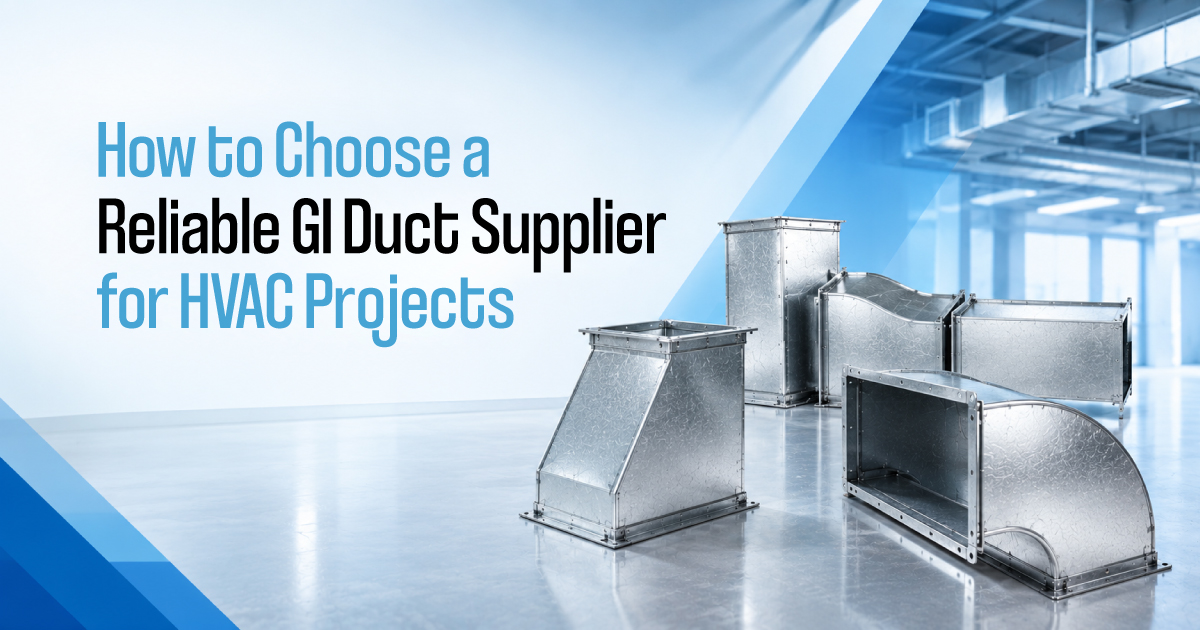
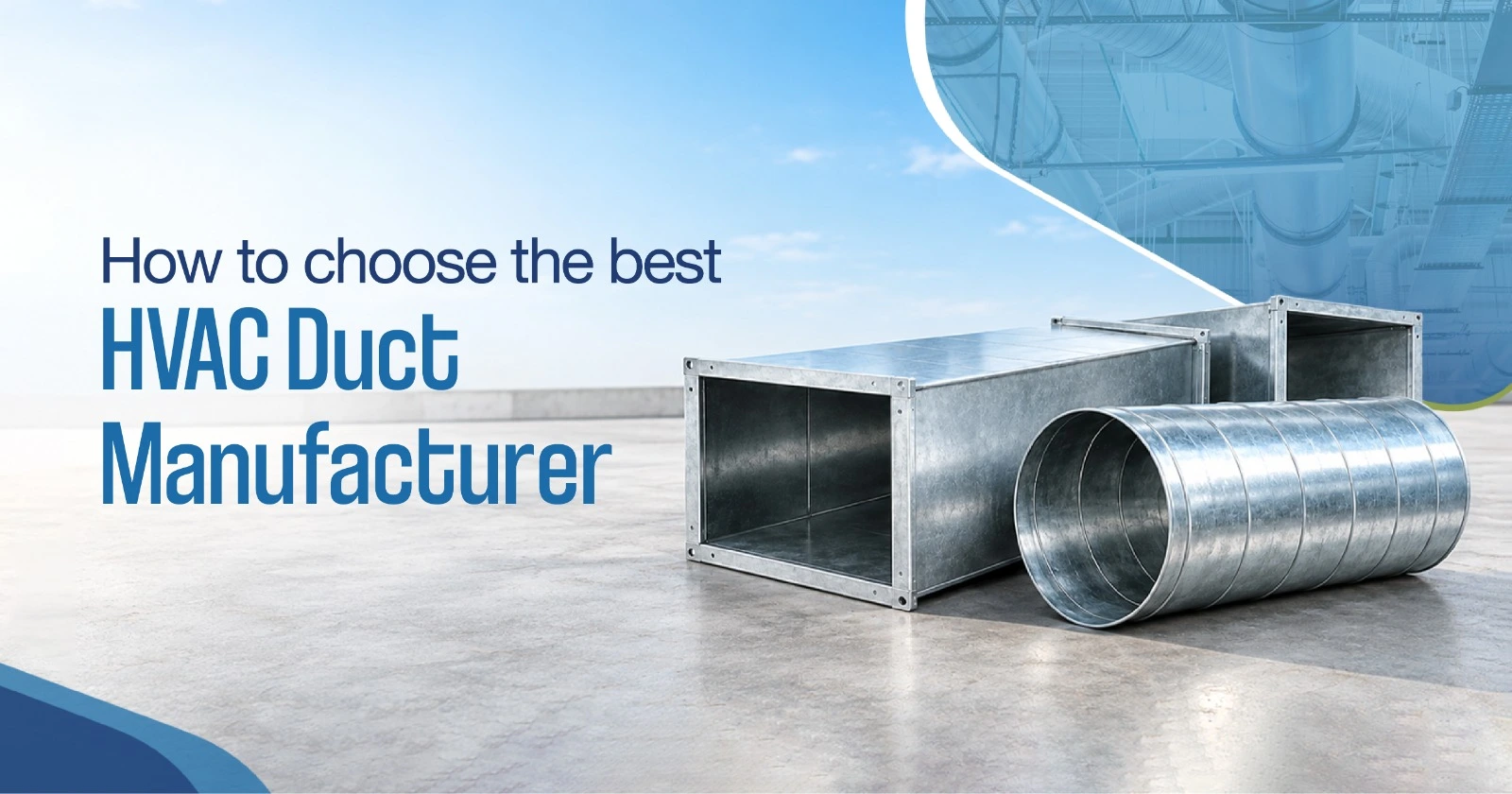
Shape matters too. Rectangular ducts fit tight ceiling voids. Spiral circular ducts leak less and install faster. Oval ducts sit between the two. A good manufacturer will make all three and advise on where each makes sense.
- Can they deliver on your schedule?
Ductwork usually sits on the critical path. If it’s late, ceilings can’t close, and every trade behind it waits.
Ask for a realistic lead time for your quantity, not a best-case number. Then ask how they’d handle a phased delivery: most contractors want ducts released floor by floor, not dumped on site in one go where they get damaged or lost.
If possible, visit the factory. Look at how busy the lines are, whether they run automated coil lines or cut everything by hand, and how finished ducts are stored and labelled. A clean, well-organized shop floor is a fair indicator of how your order will be handled.
Location counts as well. A manufacturer based in the UAE can turn around a revised batch in days. An overseas supplier may need weeks, plus customs.
- Will they work from your drawings, and catch problems in them?
Some manufacturers cut exactly what’s on the drawing and nothing more. Others have an in-house technical team that reviews the layout, flags clashes with structure or other services, and suggests fittings that are easier to fabricate and install.
The second kind saves money even if the unit price is slightly higher. One avoided site modification, where a fitter has to cut and re-seal a duct in the ceiling, can cover the difference on a whole floor.
Ask who prepares the fabrication drawings, how revisions are tracked, and who you call when something doesn’t fit on site. You want a name and a phone number, not a general inbox.
- Can they supply the accessories as well?
A duct system isn’t just ducts. It needs volume control dampers, fire dampers, access doors, grilles and diffusers, sound attenuators, and supports such as C and S channels.
When these come from different suppliers, the problems are predictable: dampers that don’t match duct sizes, access doors in the wrong place, and three delivery schedules to chase. A manufacturer that produces both the ducts and the accessories can size them together and ship them together.
It also simplifies approvals. One submittal package, one set of technical data, one point of responsibility if something is wrong.
- Have they done a project like yours?
A villa, a hospital and an airport terminal ask very different things from a duct manufacturer. Hospitals need tight leakage control and hygiene-grade materials. Towers need careful logistics for vertical delivery. Large public projects need volume and documentation.
Ask for two or three references in your sector, ideally completed in the last few years. Then call the contractor, not just the client. Ask how the manufacturer handled changes, late revisions and snags. That conversation tells you more than any brochure.
- Are you comparing quotes like for like?
Two duct quotes can differ by 20% or more and both be “correct”, because they aren’t pricing the same thing. Before choosing the cheaper one, line them up on:
- sheet gauge and galvanizing grade
- joint type, sealant and leakage class
- insulation type and thickness, if included
- whether fittings, dampers, supports and access doors are included or extra • delivery terms: to site, to floor, or ex-factory
- how revisions and variations are priced
Once these are aligned, the gap usually narrows. If it doesn’t, ask the lower bidder where the savings comes from. A clear answer is fine. A vague one is a warning.
Red flags to watch for
Some warning signs come up again and again:
- They can’t or won’t share certificates, mill certificates or a gauge schedule.
- The quote is a single lump sum with no breakdown.
- They say yes to every date without asking about quantities or drawings.
- There’s no factory to visit, or the “factory” turns out to be a trading office.
- References are all from years ago, or none are in your sector.
A quick checklist before you order
- ☐ISO 9001, 14001 and 45001 certificates checked for scope and expiry
- ☐ICV certificate, if the project is a government tender
- ☐Construction standard (SMACNA or DW/144) and leakage class confirmed
- ☐Gauge schedule and galvanizing grade compared against the spec
- ☐All required materials available in-house
- ☐Lead time and phased delivery plan agreed in writing
- ☐Accessories included, or sourcing plan confirmed
- ☐Two or more references in your sector contacted
- ☐Quotes compared like for like
Where HVAC Industries fits
We’re a duct manufacturer based in ICAD-1, Mussafah, Abu Dhabi, and we built our business around the questions above.
Our factory fabricates rectangular, spiral circular and oval ducts in galvanized steel, stainless steel and aluminium, along with pre-insulated Kimmco Climaver Neto ducts and fabric ducts. We also make the dampers, access doors, grilles, sound attenuators, acoustic louvers and C and S channels that go with
them. We hold ISO 9001, ISO 14001 and ISO 45001 certification, along with ICV certification, and we’re happy to share every certificate.
If you’re pricing a project, send us your drawings and specifications. We’ll come back with a detailed, itemized quote you can compare line by line against anyone else’s.
Request a quote or call us on +971 2 245 9312.